From Zurich to Madrid: How Far - and How Late - Your Cat Roams Depends on Where You Live
A Weenect GPS Study Across Ten Countries Reveals What Your Cat's Secret Life Really Looks Like
THE STUDY
Anonymised tracking data from around 1,000 cats wearing Weenect GPS trackers was analysed across ten countries in Europe and the US. Each cat, randomly selected, provided four weeks of continuous tracking — more than 24,000 daily records in total. The result is one of the most detailed pictures yet of how outdoor cats actually behave: how far they roam, how their habits change after dark, and how much of their territory is shaped by biology versus environment.* *952 datasets were used in the final analysis, after faulty data was removed.
Overview of Tracking Data
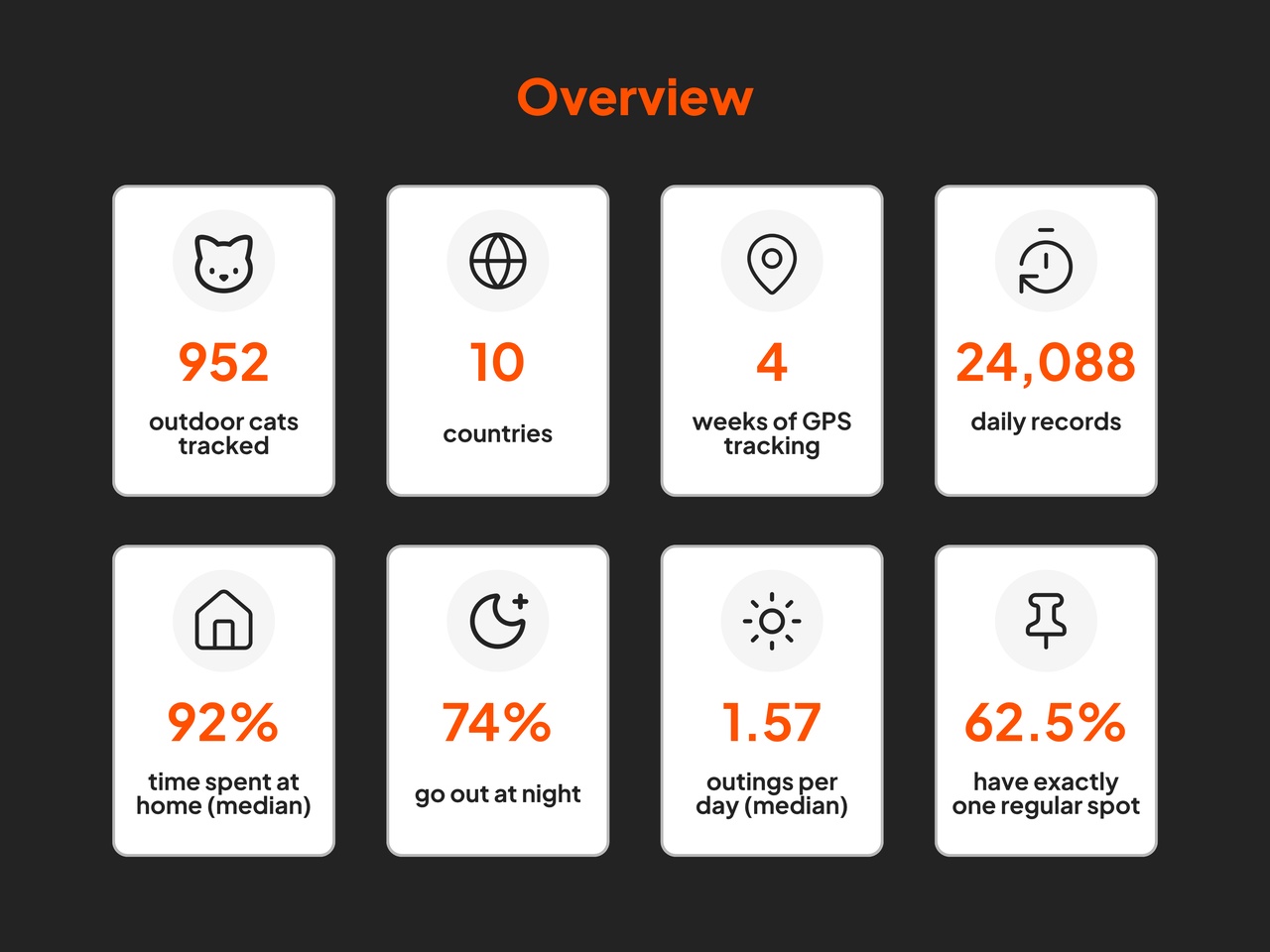
The image provides an overall view of the results from the tracking data collected
Home by Day, Wanderer by Night
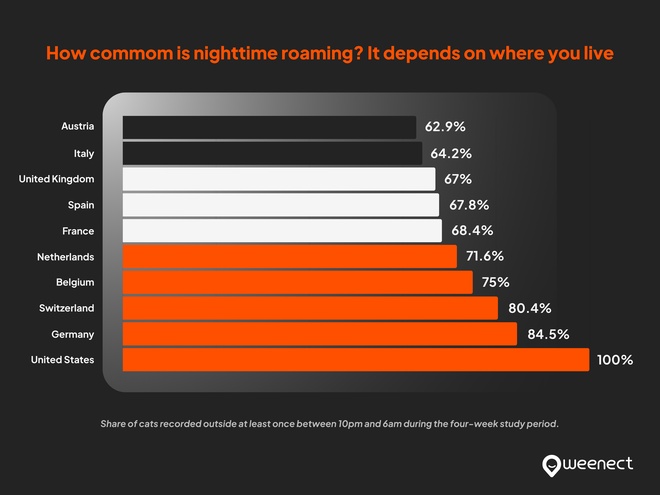
Most cats stay close - but not after dark. Across the full study, 74% of cats went outside at least once at night during the four-week observation period. For an animal often assumed to spend the evening curled up indoors, that's a notable share of quiet, after-dark activity going largely unnoticed by owners.
How common this is depends entirely on where you live. The share of nocturnal cats ranges from 62.9% in Austria to a full 100% in the United States - a gap unlikely to come down to instinct alone. It also reflects how much nighttime freedom owners in different countries are willing to grant their cats.
A Homebody By Nature
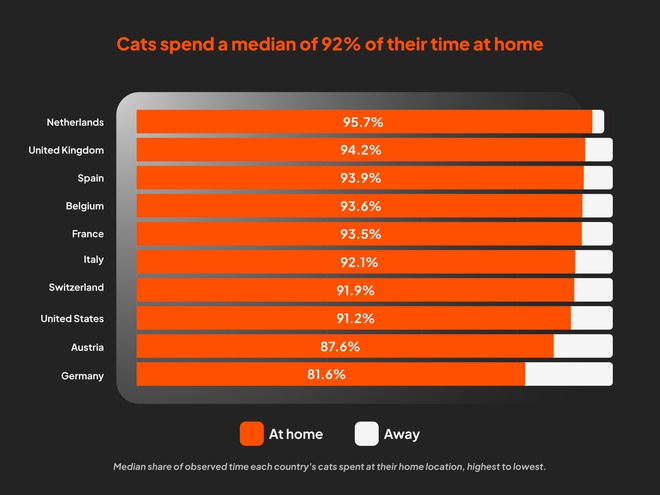
A surprisingly home-centred animal, even outdoors. Despite having outdoor access, the typical cat in this study spent a median of 92% of its time at its home location. Outdoor freedom, it turns out, doesn't translate into constant roaming.
A pattern that holds across environments. This behaviour remains remarkably consistent whether a cat lives in a city, suburb, or countryside. If anything, urban cats appear slightly more homebound, likely due to a combination of more limited space and greater owner caution.
Neutering Barely Slows Male Cats Down
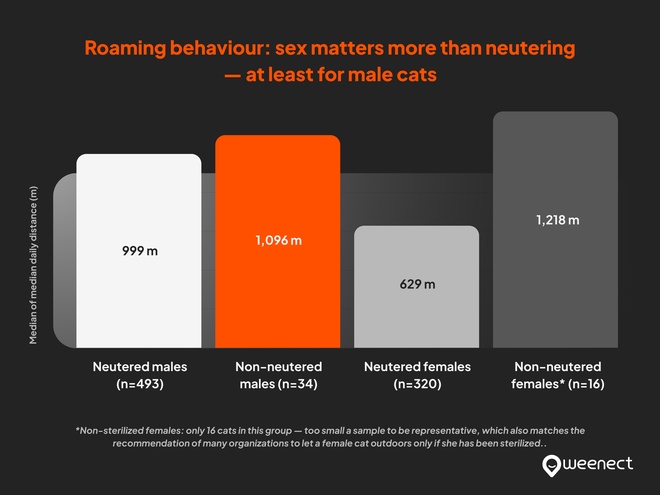
For male cats, sex predicts roaming far better than neutering status. Non-neutered males cover only around 10% more ground (by median) than neutered males - a much smaller difference than the "intact male" reputation suggests. Sex itself has a far stronger effect: neutered males still cover around 59% more ground than neutered females and go out nearly twice as often.
For female cats, the picture is less clear. Only 16 non-neutered females were tracked long enough to be included in the analysis - not enough to identify a clear pattern. This small number also reflects a wider recommendation: many animal welfare organisations, and some municipalities, advise - or even require - that female cats only be allowed outdoors once neutered, given the far higher risk of an unplanned litter.
Creatures of Habit
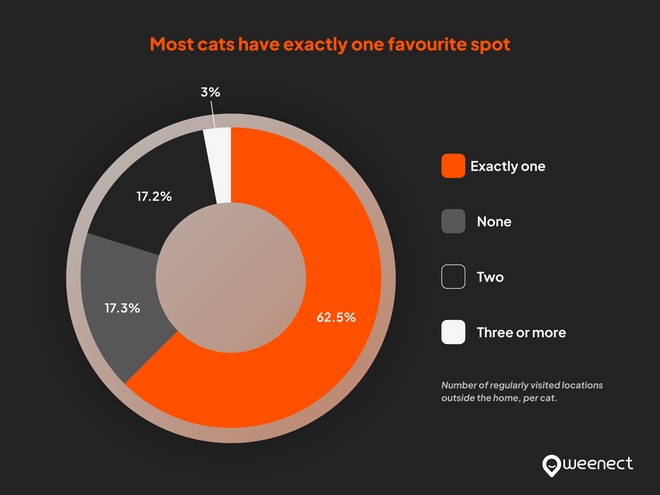
One place, visited time and again. Over 1,000 regularly visited locations were identified across the study. Of the cats with at least one regular spot outside home, the overwhelming majority - 62.5% of all cats - have exactly one. Cats, it turns out, don't wander aimlessly; they return to what they know.
Only a rare few explore further. Just 3% of cats maintain three or more distinct regular locations. A small handful go even further, with some cats keeping up to 11 separate spots in regular rotation - genuinely complex routines hiding behind an otherwise simple pattern.
City Living Means Less Territory to Call Your Own
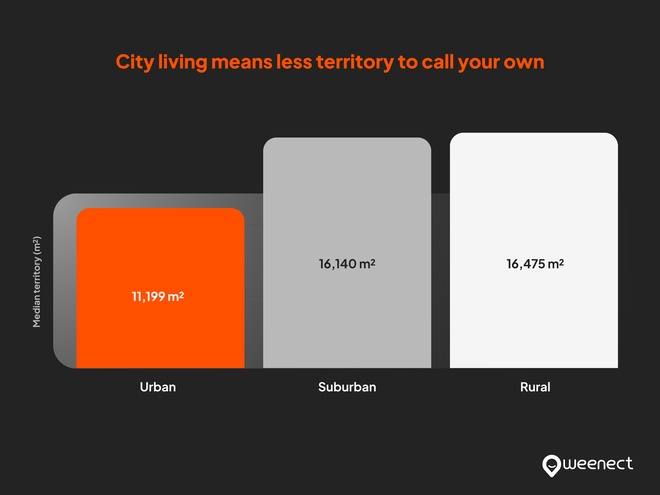
Urban cats: less room to roam. Cats living in urban environments have a median territory of around 11,200 m² - noticeably smaller than the 16,100-16,500 m² typical of suburban and rural cats.
A modest but consistent gap. The difference amounts to roughly 30-40% less territory for city-dwelling cats. Part of this likely comes down to sheer cat density: with more cats sharing the same limited space in urban areas, individual territories may simply have to shrink to fit around each other. It's a reminder that even for an animal with full outdoor freedom, the built environment - and the number of neighbours it shares that environment with - still sets real limits.
Where You Live Shapes How Far Your Cat Roams
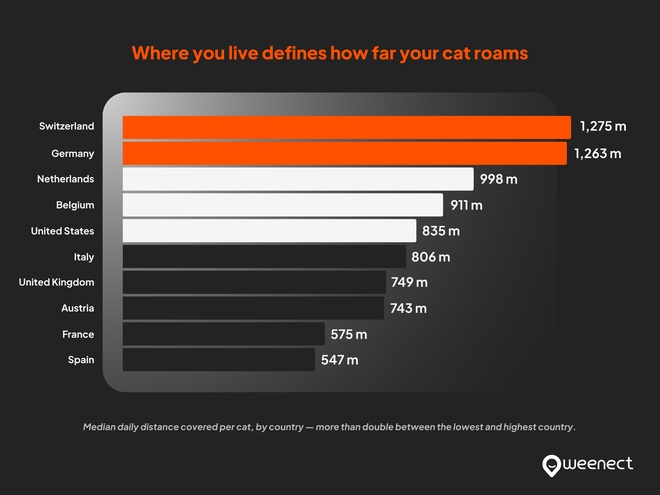
More than double between the least and most active countries. Median daily distance ranges from 547 metres in Spain to 1,275 metres in Switzerland - a gap of more than double across just ten countries. Geography, it turns out, may shape a cat's daily life more than almost any other factor we measured.
Consistency counts too. Switzerland stands out not just for distance but for consistency: the gap between the average and the median cat there is the smallest of any country, suggesting a genuinely active population rather than a few extreme individuals skewing the picture.
The Most Common Tracked Breed? No Breed At All.
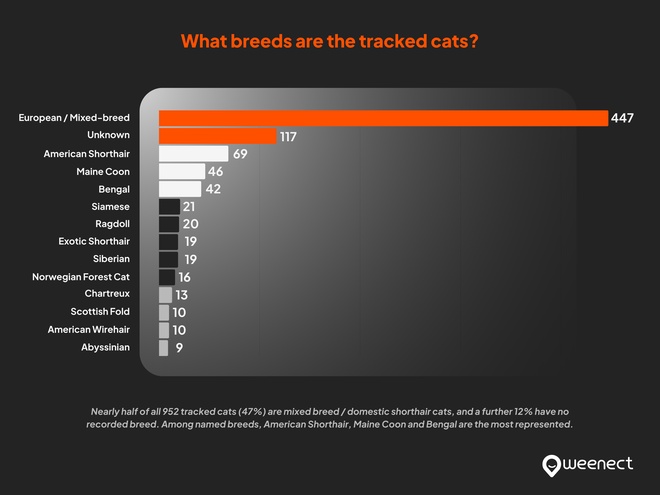
Nearly half of all tracked cats are mixed-breed cats: 47% of cats in the study are mixed-breed or domestic shorthair cats - by far the largest single group, ahead of any named breed. A further 12% have no recorded breed at all.
Among named breeds, a clear pattern emerges. American Shorthair (69), Maine Coon (46), and Bengal (42) are the most represented named breeds - all known for being active and outdoor-oriented. It's likely no coincidence: owners may be more inclined to fit a tracker to breeds they already expect to wander. There may be a second reason too: owners of rarer, more distinctive breeds may also be more cautious, as their cats are more recognisable and may attract unwanted attention.
THE THREE CAT TYPES
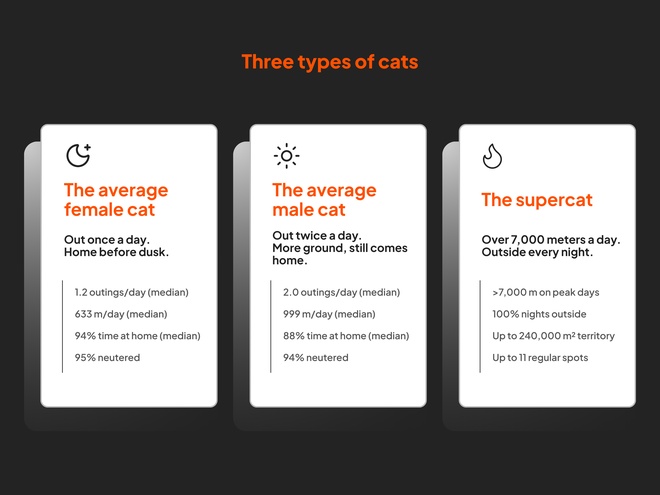
The Average Female Cat - "Out once a day. Home before dusk." Her territory is small, but she knows it by heart - usually just one fixed spot beyond the front door, rarely more than a hundred metres away. On a typical day she goes out once and covers around 633 metres. She's reliable for being home by evening, spending a median of 94% of her time at her home location. Neutered in 95% of cases, calm, low-drama - precisely the profile that rarely gives an owner reason to worry.
The Average Male Cat - "Out twice a day. More ground, still comes home." He typically has more than one fixed spot beyond home, and a noticeably larger territory than his female counterparts - around 20,000 m² versus 10,700 m², nearly double. On a typical day he goes out around twice and covers around 999 metres. He's neutered in the vast majority of cases (94%), though that barely seems to slow him down. Still, he always comes home - just by the longer route.
The Supercat - "Over 7,000 metres a day. Outside every night." This cat claims a territory of up to 240,000 square metres - roughly 30 football pitches - spread across as many as 11 distinct regular spots. On every single observation day, the cat was outside at least once at night; day and night barely register as different to it. Several of the most active cats in the dataset are Norwegian Forest Cats, a breed traditionally known for independence and a strong outdoor instinct.
COUNTRY BY COUNTRY
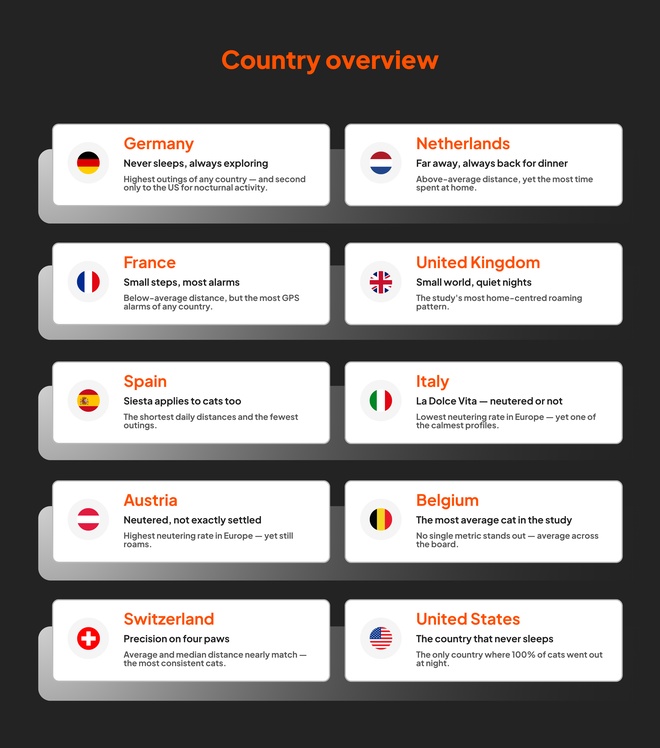
Ten countries, ten different cats. From Germany's tireless explorers to Spain's dedicated homebodies, explore how territory, activity, and habits shift from one country to the next.
CONCLUSION
Cats are creatures of habit - home-loving, territorial, and loyal to familiar places - but how much they venture out at night still varies hugely from cat to cat and country to country. The typical cat in this study spends the vast majority of its time close to home, yet three in four still slip out after dark at least once a month, revealing a side of feline life most owners rarely see.
Where a cat lives matters more than almost anything else we measured: daily distances more than double between the least and most active countries, and sex has a stronger influence on roaming distance than neutering status, with neutered male cats consistently travelling almost as far as non-neutered male cats. Geography, climate, housing, and ownership culture all appear to shape a cat's daily routine as much as biology does.
By making these hidden routines visible, GPS data helps us better understand how cats really use the world around them. From homebodies with tiny territories to supercats covering long distances each day, what shapes a cat's roaming behaviour most isn't the cat itself - it's where it lives, and who it lives with.