First AI, then the vet?
1,824 pet owners across Europe reveal how artificial intelligence is changing the way they care for, feed and shop for their pets.
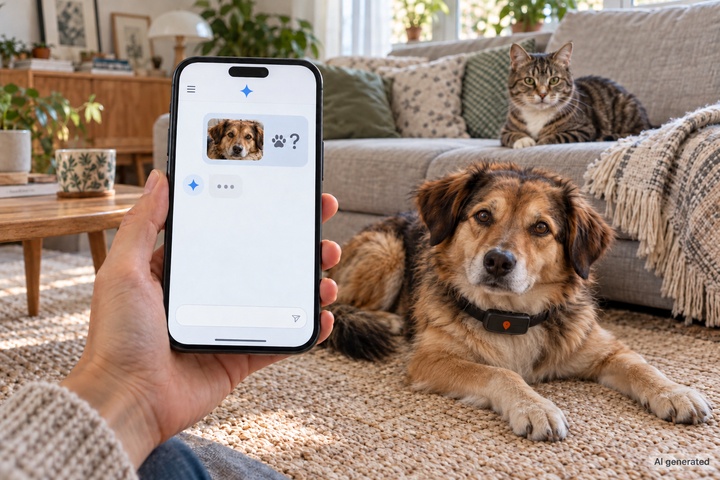
1,824 owners, nine countries, one question: how is AI changing life with dogs and cats?
More than half of respondents have already used AI for their pet. But what exactly for, who do they trust, and why are older owners the biggest AI fans? The answers are below.

Sample
In September 2026, Weenect surveyed 1,824 of its customers about artificial intelligence*, mainly in nine European countries: France, Germany, Belgium, the Netherlands, Austria, Switzerland, Italy, the United Kingdom and Spain. 941 respondents who have already used AI for their pet then answered in-depth questions on topics, trust, purchasing and their wishes for the future.
Our aim was to understand how tools such as ChatGPT or Gemini are changing everyday life with a pet: what owners ask, who they trust and how far they already let AI act on their behalf.
*Respondents are Weenect GPS tracker customers. The results are therefore not representative of all pet owners. Percentages are rounded.
At a glance
More than half of respondents (52%) have already used AI for their pet. Their vet is still the source they trust most (82%). Among AI users, almost one in two (45%) has already let AI help with a purchase, and 40% are open to AI agents that carry out tasks themselves. Four in five (81%) would use AI more if it were designed specifically for pets.
More than one in two owners have already asked AI about their pet
A new everyday habit
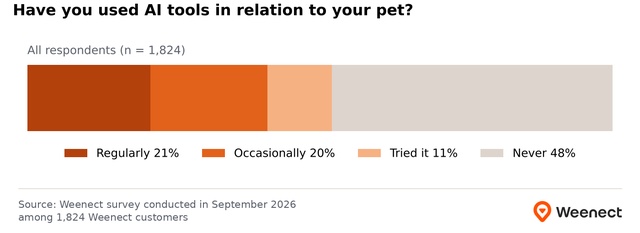
52% of respondents have used AI tools for questions about their pet: 21% regularly, 20% occasionally and 11% have tried it at least once. City dwellers use AI slightly more often (55%) than owners in the countryside (49%).
And it is growing
27% of AI users say they turn to AI more and more often, while only 5% use it less. Most (42%) use it occasionally and at a steady rate. The habit is spreading rather than fading.
ChatGPT leads, but it does not reach everyone
One clear favourite
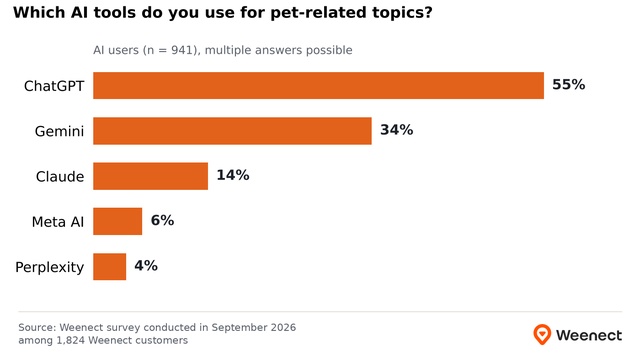
ChatGPT is the most widely used tool among pet owners (55% of AI users), followed by Gemini (34%) and Claude (14%). Meta AI (6%) and Perplexity (4%) play a minor role so far; Copilot, Mistral and Grok are also mentioned.
A more diverse picture than it seems
Almost one in three AI users (31%) names two or more tools, and almost one in four (24%) uses other assistants but not ChatGPT. Men use a wider mix than women: 42% use Gemini (women: 30%) and 20% Claude (women: 10%).
Why some owners stay away from AI
The vet and Google come first
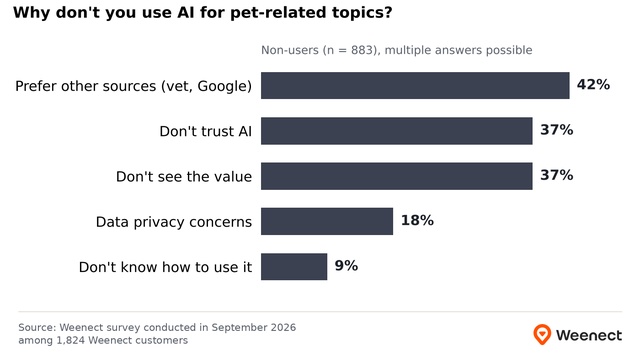
48% of respondents have never used AI for their pet. Most of them simply prefer other sources such as the vet or Google (42%). 37% do not trust AI, just as many see no benefit, and 18% have data privacy concerns.
The young sceptics
Surprisingly, the most critical non-users are the youngest. Among under-35s who do not use AI, 59% say they do not trust it and 35% cite data privacy, compared with 32% and 11% among non-users aged 65 and over.
Health first, but far more than a symptom checker
From symptoms to food and products
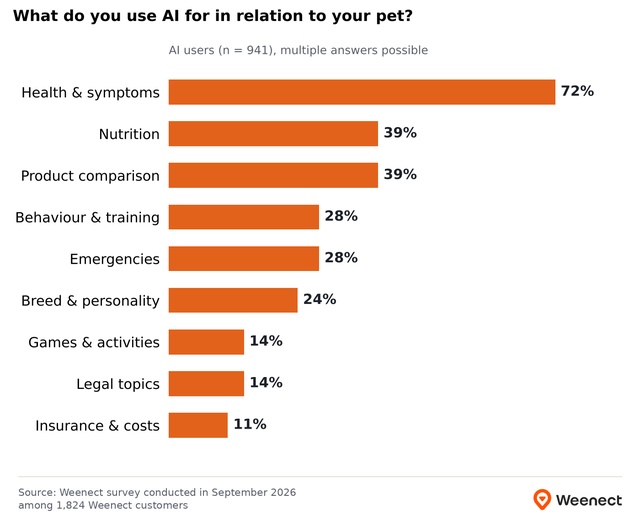
Health and symptoms are the most common topic (72%), in every country. But AI has long since become a helper for everyday questions too: 39% ask about nutrition, just as many compare products such as trackers, food or accessories, and 28% each seek advice on behaviour and training or in emergencies.
Cat owners ask, dog owners compare
Cat owners use AI slightly more often than dog owners (54% vs. 49%) and ask more about health (76% vs. 68%) and emergencies (32% vs. 23%). Dog owners compare products more often (42% vs. 36%) and are twice as likely to ask about legal topics such as travel rules (20% vs. 10%).
Not just a tool for the young
Almost the same in every age group under 65
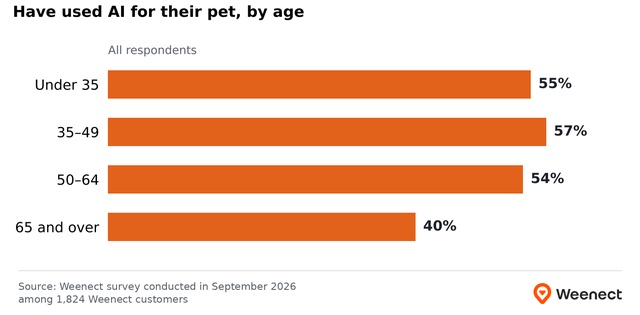
55% of under-35s, 57% of 35 to 49-year-olds and 54% of 50 to 64-year-olds have used AI for their pet. Even among owners aged 65 and over, 40% have already done so. The median age of respondents is 54.
Young owners ask about everything
Under-35s use AI the most broadly: 41% have asked it for help in an emergency (65 and over: 21%), 24% look for ideas for games and activities (8%), and 57% have let AI help with a purchase decision (30%). Owners aged 35 to 49 stand out with questions about behaviour and training (34%).
The surprise: older owners trust AI more, and let it do more
Less worried, more confident
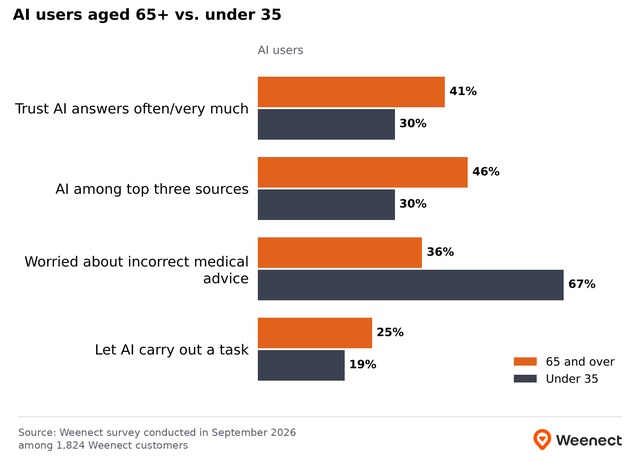
Owners aged 65 and over who use AI trust it more than any other age group: 41% trust its answers often or very much, compared with 30% of under-35s. 46% place AI among their three most trusted sources (under 35: 30%). And only 36% worry about incorrect medical advice, while among under-35s it is two in three (67%).
The over-65s delegate the most
One in four AI users aged 65 and over (25%) has already let AI carry out a task for their pet, such as ordering food or comparing prices. That is more than in any other age group. One possible explanation: younger owners grew up with digital tools and know their weaknesses, while older owners value AI as a convenient helper for routine tasks.
The vet stays first, AI and Google compete for third place
The vet has the final word
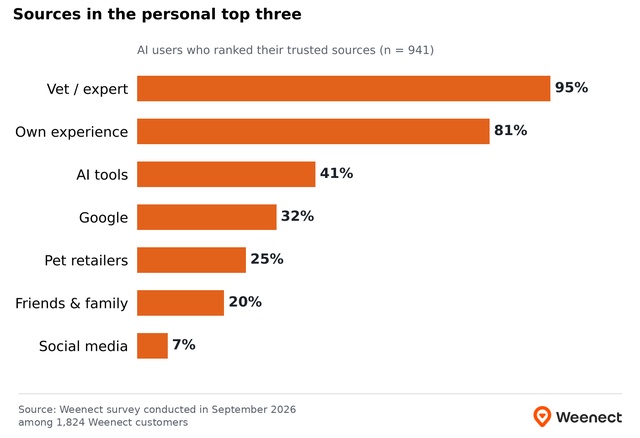
82% of AI users name the vet as their most trusted source, usually followed by their own experience. Only 2% put AI in first place, and just 7% trust it more than their vet. Behind these two, AI and Google compete for third place: 41% place AI in their personal top three, compared with 32% for Google.
Trust with reservations
Only one in three AI users (34%) trusts AI answers often or very much; 55% say “it depends” and 11% rarely or never trust them. The main concerns are incorrect medical advice (56%), unreliable or outdated information (38%), answers that do not fit their own animal (37%) and contradictory answers (34%).
AI joins the shopping trip
Almost every second AI user buys with AI
45% of AI users have let AI help with a purchase decision for their pet: for 11%, AI influenced the decision significantly, 34% used it as support. Among regular AI users, the figure rises to 62%. 39% use AI to compare products such as trackers, food and accessories.
Where the product search starts
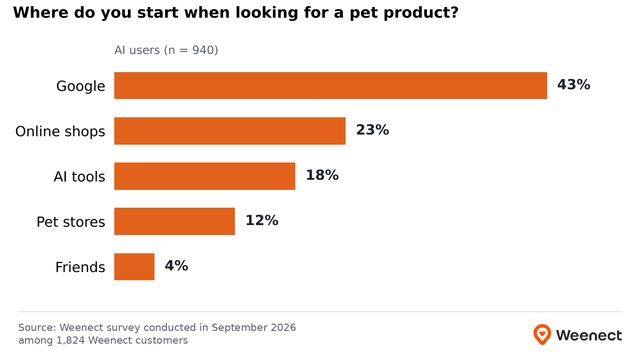
Google is still the most common starting point (43%), followed by online shops (23%). AI tools already come third (18%), ahead of local pet stores (12%). Among regular AI users, almost one in three (31%) starts with AI, men more often than women (24% vs. 15%).
From answers to actions: when AI does the job
Two in five are open to AI agents
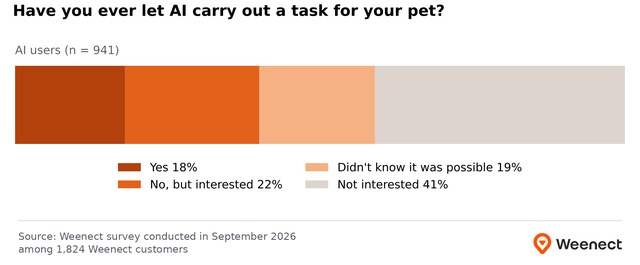
Almost one in five AI users (18%) has already let AI carry out a task for their pet, and another 22% would like to. Most often, AI compares prices (60% of agent users), followed by ordering food or accessories (31%), care reminders (24%) and vet appointments (15%).
Early adopters and an awareness gap
Rural owners (22%) delegate more often than city dwellers (16%), as do cat owners compared with dog owners (20% vs. 16%). Agent users are the most convinced group: 50% trust AI often or very much, 69% have used it for a purchase, and 35% start their product search with AI. Yet 19% did not know this was possible, women more often than men (23% vs. 14%).
Owners want an AI that knows their animal
Four in five want AI made for pets
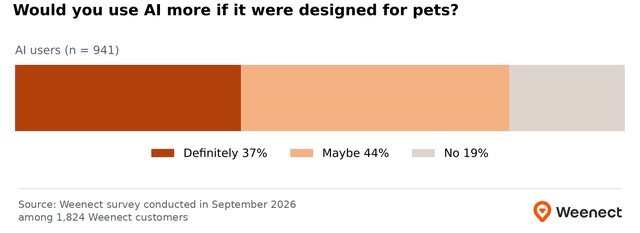
81% of AI users would use AI more if it were designed specifically for pets: 37% definitely, 44% maybe. Among regular users, 53% say “definitely”, and even among those who rarely or never trust AI answers today, 47% would be open to it.
A photo says more than a question
82% could imagine uploading a photo of a product, a symptom or their pet for AI to analyse: 37% definitely, 36% maybe, and 9% already do so.
AI is the first stop. The decision stays human.
Artificial intelligence has arrived in everyday pet ownership, across all age groups. Owners ask AI about health, food and products, and a growing number already let it compare prices or place orders. Yet for now the vet keeps the final word, and most owners check what AI tells them.
What holds owners back is not the technology itself but the feeling that general answers do not fit their own animal. Four in five would use AI more if it were made for pets. Trust comes from answers based on what is normal for each individual animal.
That is how Weenect approaches technology. Our GPS trackers record a pet’s location and daily activity, so owners can see what is normal for their animal and notice when something changes. We rely on clear, reliable signals rather than false alarms, and the decision always stays with the people who know their animal best.